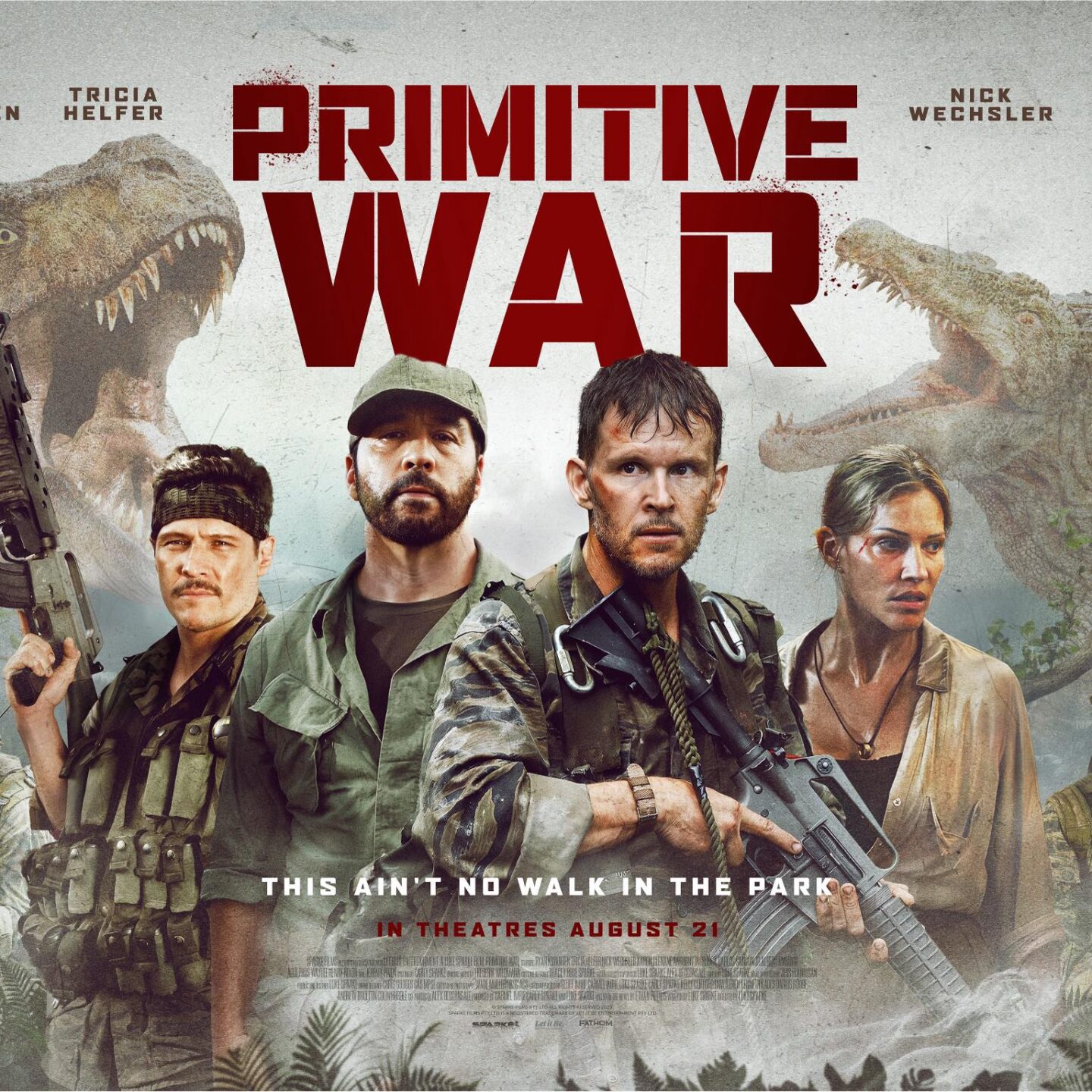
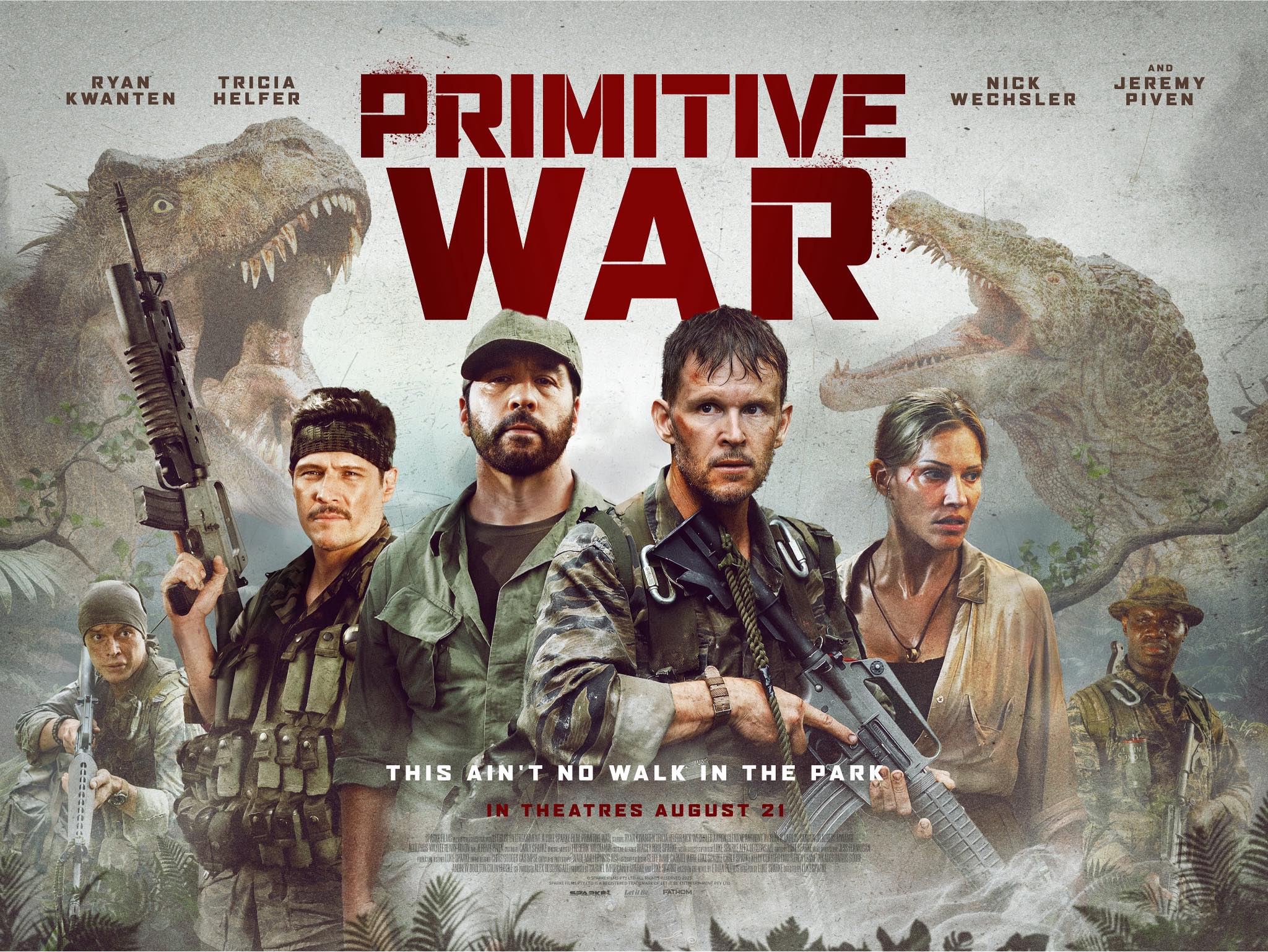
When I heard that they were adapting Ethan Pettus’ novel Primitive War into a movie, I decided it was finally time to pick up this indie favorite. When I finished reading the novel, I thought, “Thank goodness a movie is coming out—a good screenwriter will know how to streamline the story to improve its impact.” I was half right.
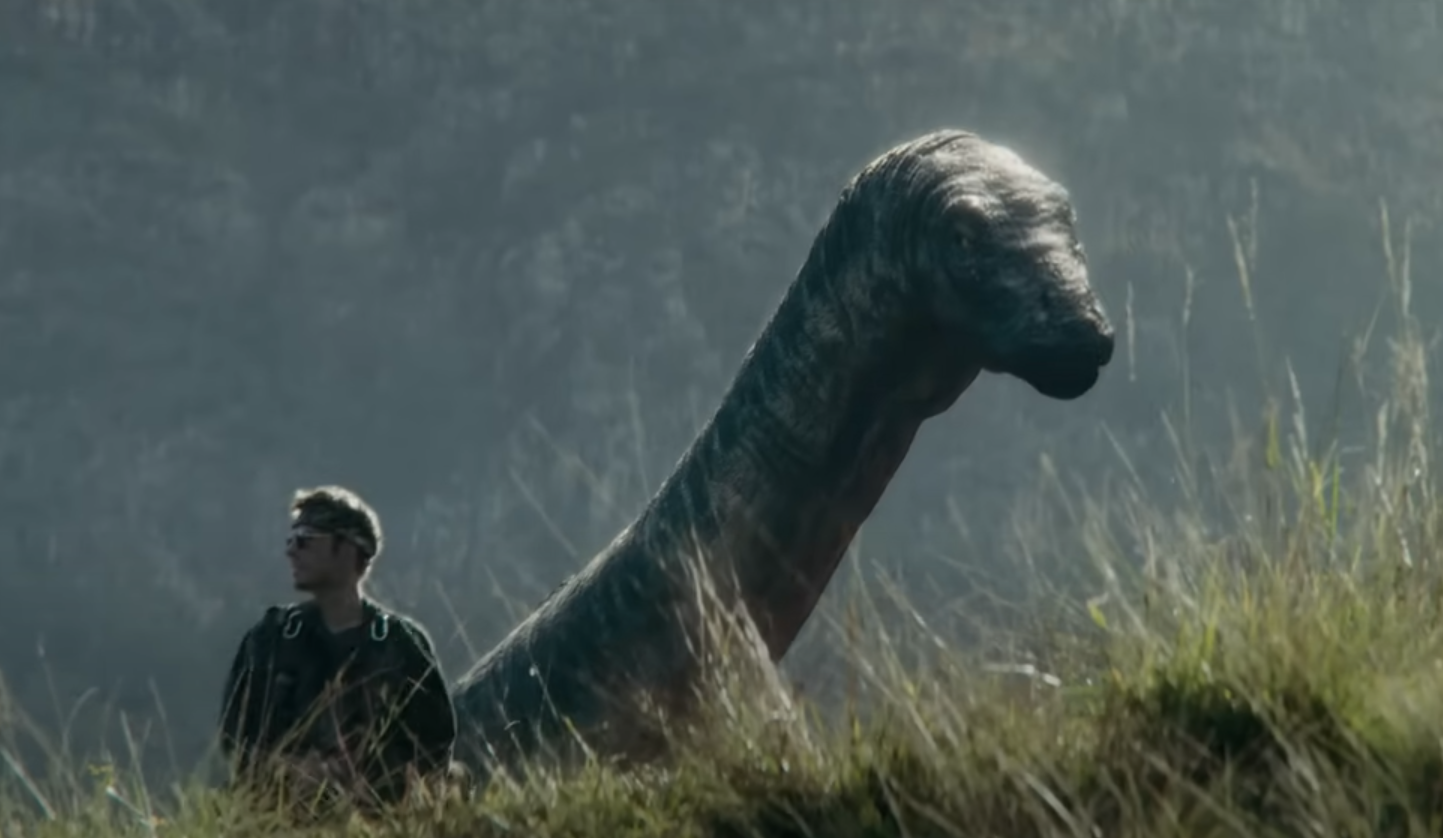
The Primitive War movie knows that its primary attraction is dinosaurs, and it puts them front and center almost from the very beginning until the end. Often, this is through some action sequences, which range from the tense and thrilling to the poorly blocked to the downright boring. However, Primitive War also gives us exceptional views of dinosaurs just living their lives in their new home. The variety of dinosaurs employed is wonderful, even if the effects are quite spotty.
A Different Look at Dinosaurs
It’s important to praise Primitive War as one of only a few big-screen dinosaur movies outside of the Jurassic Park franchise in recent years. This matters because the increasingly antiquated JP franchise is showing its inability to effectively explore all the potential themes related to a world where humans and dinosaurs live side by side. It sometimes brings up interesting ideas but flubs the execution or simply drops the idea altogether.
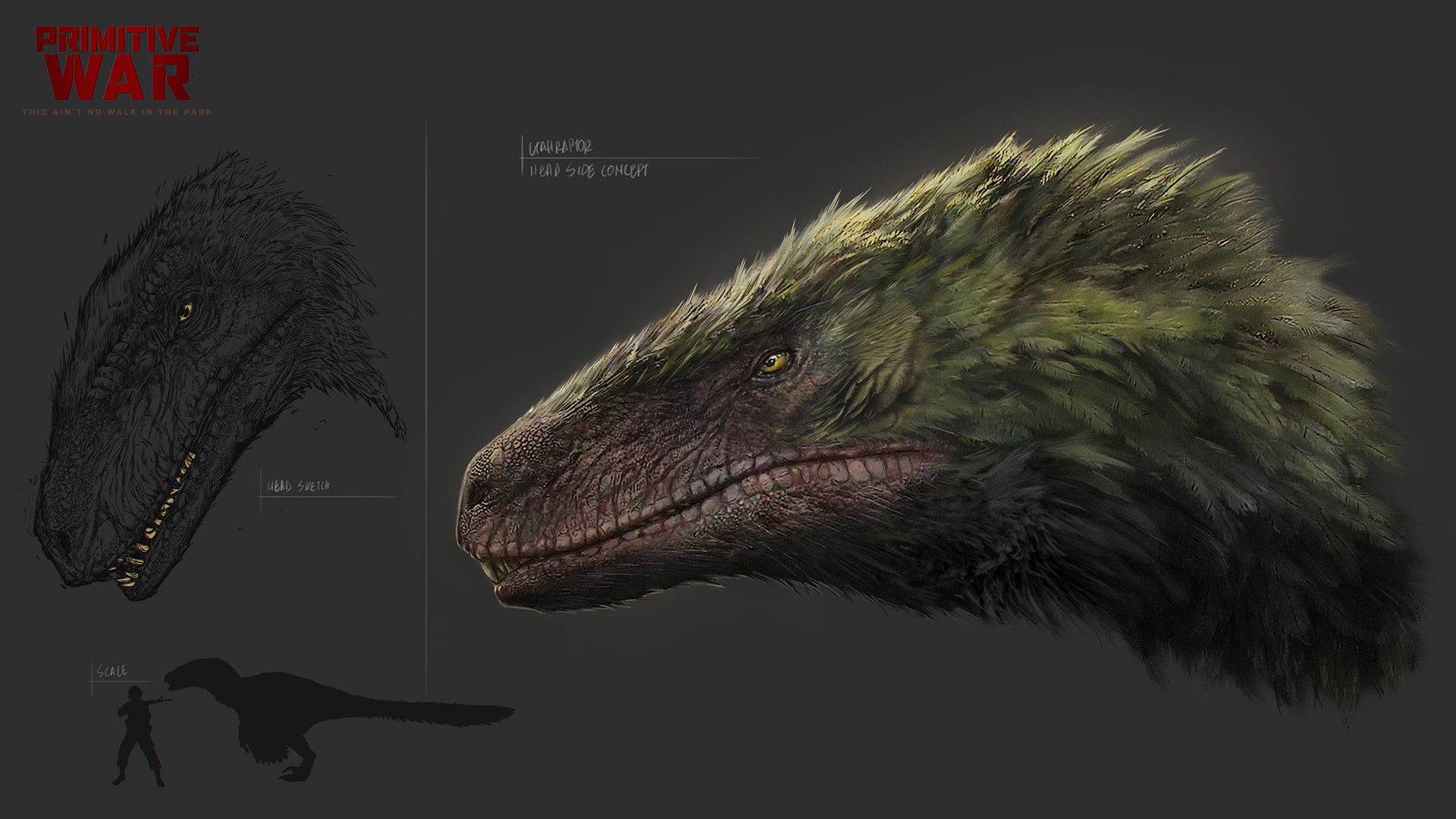
Primitive War brings its own perspective on dinosaurs to the movies. Most visibly, this is in the use of feathered dromaeosaurs. In the movie these come in three distinct sizes: an unnamed small variety, Deinonychus in medium size, and Utahraptor for the scary large size. Nicely, the movie removes the anachronistic reference to them by name used (with acknowledgement) in the novel. She simply calls them a larger species or dromaeosaur than she knows about, which is nice because the dinosaur wouldn’t be described until 1993. Ironically, though, she accepts the feathered dromaeosaurs without question, even though evidence for them having feathers wouldn’t be presented until 1999. (In all fairness, the thought that dinosaurs were closely related to birds and might be feathered was tossed around for decades after the discovery of Archaeopteryx. However, the movie is set in 1968, dead in the middle of reptilian dinosaur thinking, and people at this time would likely be quite surprised that dinosaurs are feathered.)
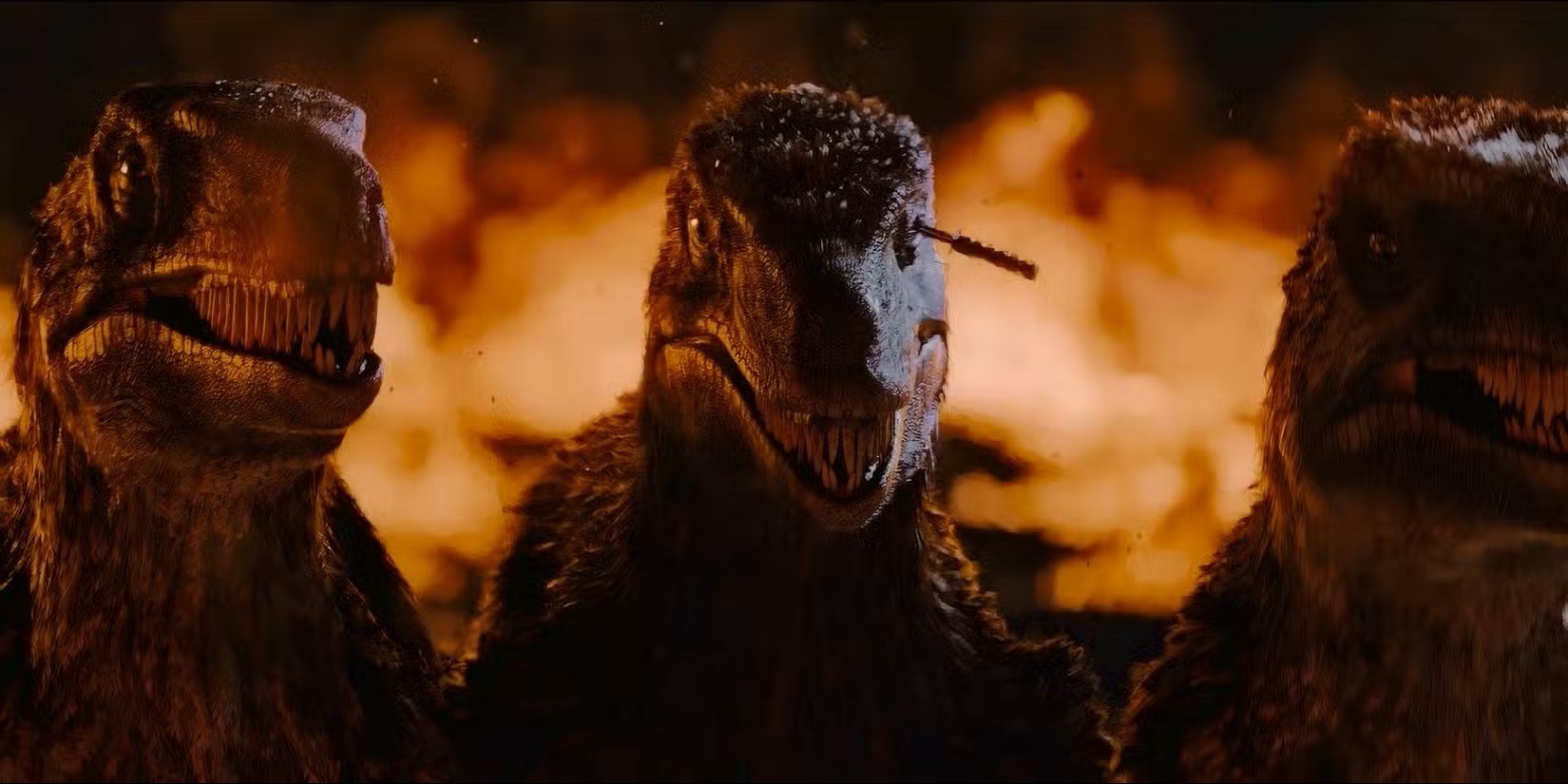
I think this movie puts to rest once and for all the conceit that feathered dinosaurs can’t be scary. The feathered dromaeosaurs in this movie have no trouble putting on their frightening faces.
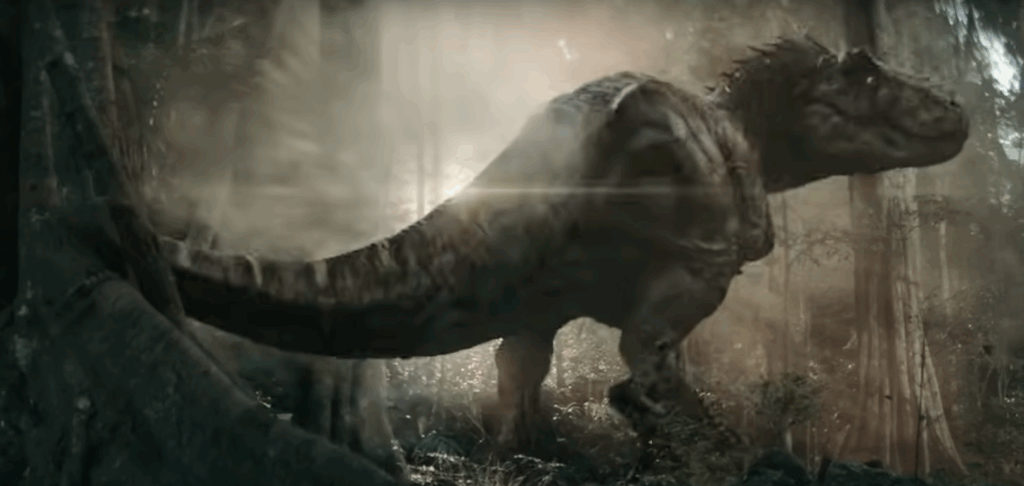
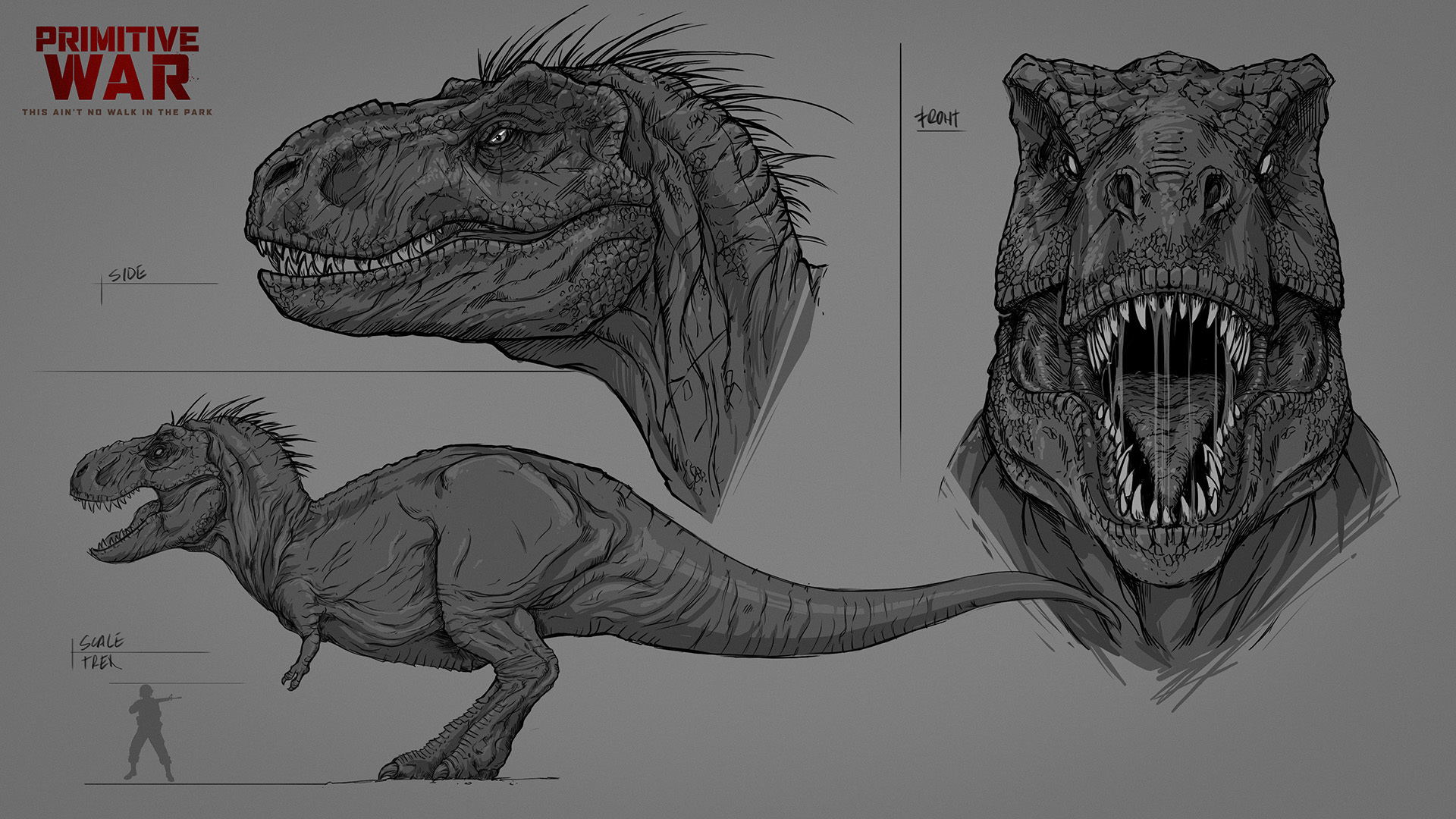
The design of other dinosaurs is also refreshing. The Tyrannosaurs don’t have the charisma of JP’s rexes, as they look a little lumpy and bloated. However, they have distinct skin patterns that could serve as camouflage. Plus, the use of pin-feathers as a marker of sex and age is nice. The brief glimpse of Amargasaurus’ attractive spine membranes was cool. Triceratops’ colorful shields were also nicely done. Spinosaurus has a sinusoidal sail in keeping with modern reconstructions, just as in the recent Jurassic World: Rebirth, but it is not as mealy-mouthed as that movie’s version. The diplodocids are perhaps the most disappointing reconstruction as they have a weirdly unfinished-looking head and body.
Nicely, the movie preserves some of the best dino-moments from the book. The soldier getting eaten alive while pinned under a Utahraptor (likely inspired by Dr. Grant’s monologue at the beginning of JP), and the Quetzalcoatlus’ disgusting tongue eviscerating its prey are both well done.
The movie tries at several points to say that the dinosaurs are animals, not monsters. The dino montage and a few other moments back this up. However, the movie (like its source material) creates dinosaurs that act in monstrous ways, making it hard to accept this position. To be fair, most dinosaur movies, TV shows, and novels struggle with this point. Perhaps the best at making dinosaurs seem like animals is Jurassic World, which at least tries to explain the monstrous behavior of its beasts as a natural outgrowth of their genes and upbringing.
A Stripped-Down Story
As I mentioned, the screenwriters did streamline the novel, which it desperately needed. Redundant actions, characters, and locales were eliminated to present a more straightforward story that makes at least as much sense as Pettus’ original version. Draggy exposition is cut in favor of pithy non-explanations. If you are a big fan of the novel, though, there are a few things you will miss.
The biggest problem with the streamlining is that most of Pettus’ characters get scant development in the film. They are introduced and given a brief hint at having a second dimension, but they don’t have time to become really distinct, so that we care little about them as they die. Only Logan and Baker are memorable. Personally, I felt that Pettus’ characters were repetitive and annoying in the novel and would have benefitted from editing, but the movie removes too much, really undercutting their value. A better screenwriter could have hit a middle ground.
Some people might also object to cutting out the sequence where one of the squad gets captured and tortured by the VC. Personally, I thought that part of the novel was dead weight, and I was glad it was gone.
One area of the story that should have been cut completely is the Russian soldiers hunting Vulture Squad through the jungle. This part of the movie was so poorly done that every minute of screen time it takes would have been better used for development of the main characters.
Poor Production Is Par for the Course
Unfortunately, there are many places where the movie’s poor production values show through. You know you are watching a low-budget family-run flick, and it sometimes makes the movie hard to take seriously.
Perhaps the most obvious failing of the movie is that almost nobody can perform a convincing Russian accent. In the showing I attended, the initial response when Russian soldiers spoke was silent shock, followed by scattered laughter that got louder each time they delivered a line of dialogue. Even poor Tricia Helfer starts with an abysmal Russian accent that makes her character impossible to believe. After a few minutes of screen time, she announces that she isn’t Russian, but was born in East Berlin, and her Russian accent is (thankfully) never heard again.
The movie was clearly not filmed in Vietnam, but at least it wasn’t filmed entirely in a green screen studio, either. I’ll take that as a compromise.
Effects suffered in many places. The biggest failing was that the director, actors, and effects people often failed to sync the effects to the live action motions. People are punching the air and dinosaurs seeming to bounce off an invisible wall on several occasions. Combine this with poorly blocked action sequences that got repetitive, and the effect was having many of the action sequences blunted. Instead of cheering or gripping the arm of your seat, you might find yourself yawning during the big dinosaur fights. Even the eaten-alive sequence has a few odd effects that make it hard to immerse yourself in the moment. It’s still good, but it could have been better.
There are some dubious choices made by the foley artists as well. Sometimes you can’t believe your ears, and even a tense moment becomes ridiculous.
Dialogue ranges from ludicrous to passable. Sometimes, Primitive War seems to embrace the bad dialogue, encouraging us to groan or laugh, but other times it seems to ask us to take it seriously, and it’s hard to do both.
An Enjoyable, If Flawed Flick
In the end, Primitive War promises dino action, and it delivers on that almost from the very beginning. The dinosaur designs are laudable, and they’re great to look at, even if they don’t always look or feel real. You’ll have fun just watching the dinosaurs, which are well worth the price of admission.
Everything else, while diminishing from the movie’s impact, is not a deal-breaker. Go in expecting the best Sy Fy movie of the week ever made and you won’t be disappointed.
And, if we’re lucky, we won’t be disappointed in expecting a sequel to pick up the premise that Jurassic World: Fallen Kingdom introduced but the franchise failed to deliver on: a world where humans and dinosaurs have to find a way to live together long-term.